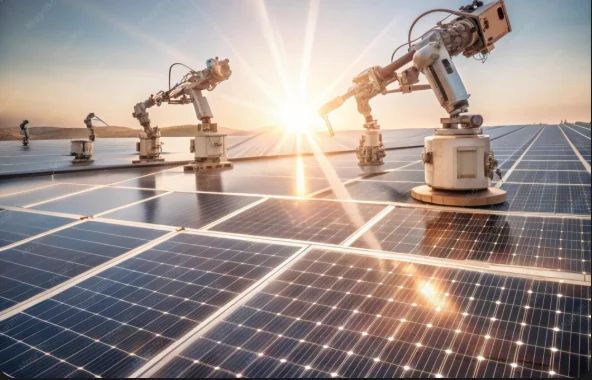
Renewable Energy Technology
Overview
Job Growth
N/A
Duration
N/A
Avg. Salary
N/A
Career Paths
N/A
Program Description
Renewable Energy Technology teaches how to capture and use energy from natural sources such as sunlight, wind, water and biomass. Students study physics, electrical principles, thermodynamics, chemistry, mathematics and environmental science, with practical laboratory and field work on solar panels, batteries and small wind systems. The program builds skills in research, experimentation, data analysis, instrument calibration and safe laboratory practice. Graduates can work as research scientists, laboratory technicians, environmental scientists, quality control analysts or become science teachers. This hands-on pathway prepares you for jobs in solar companies, mini-grid projects, government energy programs and research centres, helping Ghana move toward cleaner, reliable energy.
Aims & Objectives
Develop practical competence in installing, testing and maintaining small-scale solar and wind systems, measured by successful lab projects and field tests.
Master laboratory techniques and safety procedures, demonstrated through accurate experiments, proper documentation and safe handling of equipment.
Understand core energy science principles in physics, chemistry and mathematics, shown by passing assessments and applying concepts in practical tasks.
Collect and analyse energy data using statistical methods, producing clear reports and charts for project evaluations.
Why Choose This Program?
Growing job market
Ghana and West Africa are expanding solar, mini-grid and off-grid projects, creating demand for technicians, analysts and researchers.
Hands-on learning
Strong emphasis on laboratory experiments, field tests and real equipment gives practical skills employers value.
Practical career pathways
Leads directly to technician and laboratory roles, and provides a foundation for further study in engineering or environmental science.
Industry links and internships
Programs often connect students with solar companies, research centres and government projects for placements and projects.
Skills & Tools
Skills You'll Develop
Measure panel output, diagnose faults, size small arrays and evaluate performance under different conditions.
Use sensors and dataloggers, apply Excel, Python or statistical tools to analyse irradiance, output and efficiency trends.
Perform experiments, follow safety protocols, prepare lab reports and maintain accurate scientific records.
Calibrate multimeters, anemometers and charge controllers, and carry out routine maintenance to ensure reliable measurements.
Tools & Resources
PVsyst or RETScreen for system sizing
MATLAB or Python for data analysis
Excel and statistical tools
Arduino IDE for basic control and data logging
Challenges & Tips
Challenges
Weak background in mathematics and physics
Limited access to well-equipped labs
Tips & Advice
Strengthen fundamentals with extra lessons, online modules and practice problems before practical courses.
Join school clubs, seek partner institutions, use online simulations and document skills with DIY projects.
Video Guide
Frequently Asked Questions
Ready to Apply?
Find programs that match your grades and interests - even if you haven't written WASSCE yet
Loading.. Please wait.

Talk to a Professional
Join a mentorship session with real professionals working in your field of interest.
 Real industry professionals
 Small groups (10-15 students)
 Starting at GH₵ 15 per session