Renewable Energy Engineering
Overview
Job Growth
N/A
Duration
N/A
Avg. Salary
N/A
Career Paths
N/A
Program Description
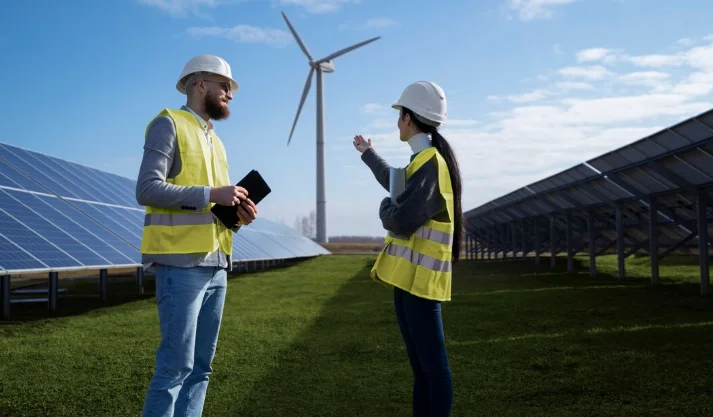
Renewable Energy Engineering teaches students how to design, build, and maintain clean energy systems such as solar PV, small wind, and battery storage. You will study core subjects in electrical principles, power electronics, thermodynamics, mathematics, programming, and system design. The program includes hands-on labs, technical drawing, and project work on real-world devices and mini-grids. Graduates can pursue careers as electrical or mechanical engineers, renewable energy technicians, project managers, software or systems engineers, and IT support specialists in utilities, solar companies, NGOs, and government energy agencies. This program prepares you to solve energy challenges, innovate with technology, and contribute to Ghana's energy future.
Aims & Objectives
Develop practical skills in designing and sizing solar PV and small wind systems, assessed through lab projects and a capstone design.
Master fundamental power electronics and electrical installation techniques, measured by practical tests and wiring exercises.
Understand mathematical modeling and simulation of energy systems using tools like MATLAB, demonstrated by simulation assignments.
Create technical documentation and project proposals, evaluated by written reports and presentations.
Why Choose This Program?
High job demand
Ghana is expanding off-grid and grid-tied renewable projects, creating demand for technicians and engineers in private firms, utilities, and NGOs.
Hands-on learning
Courses include laboratory work, field installations, and capstone projects that build practical, employer-ready skills.
Multidisciplinary skills
You gain electrical, mechanical, programming, and project management abilities, which open diverse career paths.
Industry links and internships
Programs often partner with solar companies, utilities, and research centers for internships, site visits, and placement opportunities.
Skills & Tools
Skills You'll Develop
Calculate load, choose panels and inverters, and design arrays for grid-tied and off-grid systems using design tools.
Work with inverters, charge controllers, converters, and protection devices to integrate renewable sources with batteries and grids.
Use MATLAB, Simulink, or HOMER to model system performance, energy yield, and economic feasibility.
Produce circuit diagrams, system layouts, and clear technical reports using AutoCAD or similar drafting tools.
Tools & Resources
MATLAB and Simulink
PVsyst or HOMER for system modeling
AutoCAD or similar CAD software
Arduino IDE for control and data acquisition
Challenges & Tips
Challenges
Strong math and physics foundation required
Balancing theory and hands-on practice
Tips & Advice
Strengthen algebra, trigonometry, and basic circuit theory early, use tutoring and online exercises.
Prioritize lab sessions, join club projects, and apply class concepts in small builds.
Video Guide
Frequently Asked Questions
Ready to Apply?
Find programs that match your grades and interests - even if you haven't written WASSCE yet
Loading.. Please wait.

Talk to a Professional
Join a mentorship session with real professionals working in your field of interest.
 Real industry professionals
 Small groups (10-15 students)
 Starting at GH₵ 15 per session