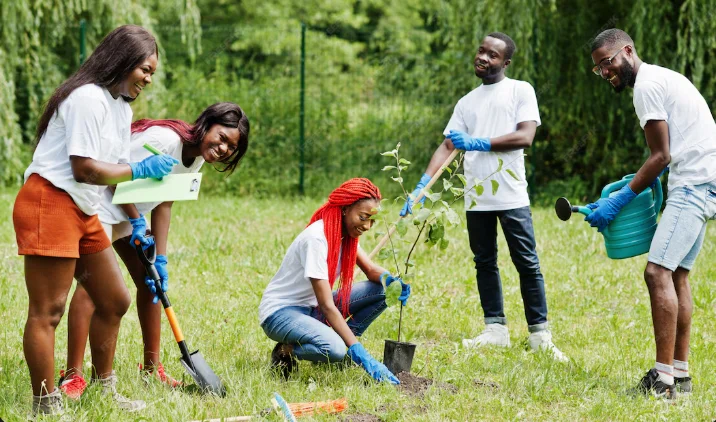
Development and Environmental Studies
Overview
Job Growth
N/A
Duration
N/A
Avg. Salary
N/A
Career Paths
N/A
Program Description
Development and Environmental Studies in the Built Environment teaches how to plan, design, build, and manage safe, healthy and sustainable physical spaces. Students learn site analysis, building design basics, construction methods, environmental impact assessment, and planning principles. Main subjects include architecture fundamentals, urban planning, surveying, construction technology, and environmental management. The program opens pathways to careers like architect, urban planner, construction manager, surveyor, and environmental consultant, and supports further study at polytechnics and universities. If you enjoy drawing, solving problems, and improving communities, this program gives practical skills and real-world opportunities to shape Ghana's towns and infrastructure.
Aims & Objectives
Develop accurate site analysis reports, including mapping, topography and basic soil observations, for at least three sample sites.
Master basic technical drawing and Computer-Aided Design, producing scaled floor plans and elevations using CAD software.
Understand and complete a simple environmental impact assessment, identifying key impacts and proposing mitigation measures.
Create sustainable design solutions that meet local building codes and accessibility standards, demonstrated through class projects.
Plan and manage a small construction task, producing a basic schedule, materials list, and cost estimate.
Why Choose This Program?
Strong career demand
Built environment skills are needed for Ghana's growing cities and infrastructure projects, providing steady job prospects in both public and private sectors.
Hands-on, practical training
Students gain practical experience through site visits, field surveying, design projects, and industry-linked workshops that build job-ready skills.
Multiple career pathways
The program leads to diverse roles, from design and planning to construction management and environmental consulting, allowing students to choose based on interests.
Opportunities for internships
Many training schools and firms offer attachments and internships, helping students build portfolios, professional networks, and real work experience.
Skills & Tools
Skills You'll Develop
Use software such as AutoCAD to produce accurate plans, elevations and technical drawings for buildings and site layouts.
Learn basic BIM workflows with tools like Revit to coordinate design, detect clashes, and visualize construction sequences.
Conduct site measurements, create site maps, and use GIS tools such as QGIS for spatial analysis and planning.
Assess how projects affect land, water and communities, and propose mitigation and sustainability measures.
Tools & Resources
AutoCAD or similar CAD software
Revit or other BIM tools
QGIS for spatial analysis
Challenges & Tips
Challenges
Difficulty with technical drawing and spatial reasoning
Strong math and science requirements
Tips & Advice
Practice sketching regularly, use grid paper, and follow step-by-step CAD tutorials to build confidence.
Focus on strengthening geometry, trigonometry and basic physics through extra classes and online lessons.
Video Guide
Frequently Asked Questions
Ready to Apply?
Find programs that match your grades and interests - even if you haven't written WASSCE yet
Loading.. Please wait.

Talk to a Professional
Join a mentorship session with real professionals working in your field of interest.
 Real industry professionals
 Small groups (10-15 students)
 Starting at GH₵ 15 per session