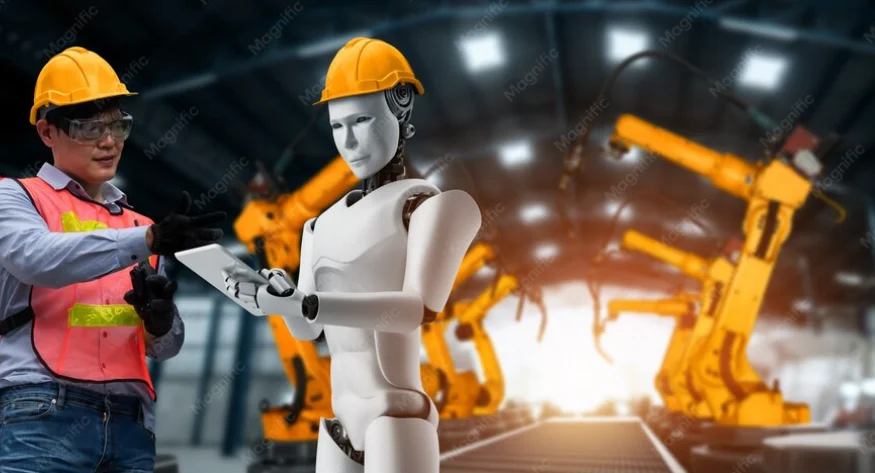
Artificial Intelligence and Robotics
Overview
Job Growth
N/A
Duration
N/A
Avg. Salary
N/A
Career Paths
N/A
Program Description
Artificial Intelligence and Robotics teaches you how to design, build, and maintain intelligent machines and automated systems. You will study programming, mathematics, electronics, mechanics, control systems, and introductory machine learning. Hands-on work includes building robot prototypes, writing code for sensors and actuators, and testing simple AI models. The program leads to careers such as Software Engineer, Electrical Engineer, Mechanical Engineer, Robotics Technician, IT Support Specialist, and roles in automation and system design across industry. If you enjoy problem solving, creativity, and technology, this program gives practical skills and a pathway to further study or technical jobs in Ghana and beyond.
Aims & Objectives
Develop programming skills in Python and C, demonstrated by completing projects that control sensors and actuators.
Build and test basic robotic systems, shown by creating a working prototype that performs a specified task.
Understand mathematical modeling and control principles, measured by solving applied problems in kinematics and PID control.
Create technical documentation and manage small projects, evidenced by project reports and presentations.
Why Choose This Program?
Strong job demand
Automation and AI are growing in Ghana and worldwide, creating roles in software, hardware, and systems maintenance.
Hands-on learning
You get practical experience building robots and coding controllers, which employers value.
Interdisciplinary skills
Combines maths, programming, electronics, and mechanics, preparing you for diverse engineering careers.
Pathways to further study and internships
Leads to university or polytechnic degrees, and opportunities for internships with local tech firms and labs.
Skills & Tools
Skills You'll Develop
Write code in Python and C/C++, develop algorithms for data processing, and implement control logic for robots.
Use Arduino and Raspberry Pi to interface sensors and motors, and deploy real-time control code.
Train simple models for perception and decision making using libraries like TensorFlow or scikit-learn.
Design mechanical parts and simulate systems using CAD tools and basic physics simulators for prototype development.
Tools & Resources
Python and libraries (TensorFlow, scikit-learn)
Robot Operating System (ROS) or basic robotics frameworks
CAD software (Fusion 360 or similar)
MATLAB or alternatives for simulation
Challenges & Tips
Challenges
Steep math and programming learning curve
Balancing theory and practical work
Tips & Advice
Start with basics, practice daily, use online beginner courses, and ask teachers for extra help.
Schedule hands-on sessions after learning concepts, and work on small projects to reinforce theory.
Video Guide
Frequently Asked Questions
Ready to Apply?
Find programs that match your grades and interests - even if you haven't written WASSCE yet
Loading.. Please wait.

Talk to a Professional
Join a mentorship session with real professionals working in your field of interest.
 Real industry professionals
 Small groups (10-15 students)
 Starting at GH₵ 15 per session