Applied Chemistry
Overview
Job Growth
N/A
Duration
N/A
Avg. Salary
N/A
Career Paths
N/A
Program Description
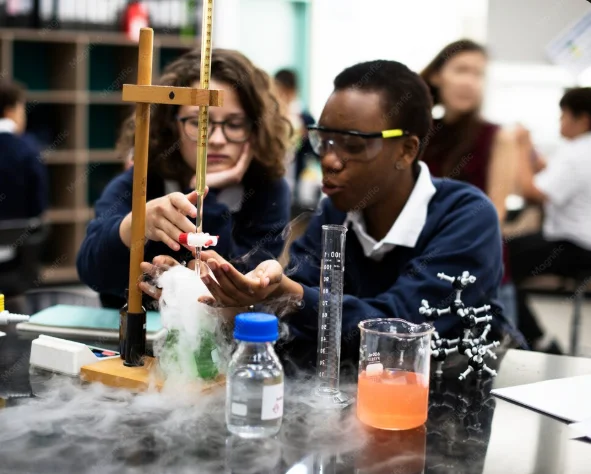
Applied Chemistry applies chemical knowledge to solve real problems in industry, health, environment, and research. Students study core areas such as organic, inorganic, physical, analytical chemistry, laboratory techniques, mathematics, physics, and environmental science. The program combines classroom theory with hands-on experiments, data analysis, and report writing. Graduates can pursue careers as research scientists, laboratory technicians, environmental scientists, quality control analysts, or science teachers, and can work in industry, public health, environmental agencies, and research institutions. If you enjoy experiments, clear thinking, and practical problem solving, Applied Chemistry opens doors to scientific work and further study.
Aims & Objectives
Develop safe and accurate laboratory techniques, measured by competency in practical assessments and adherence to safety checklists.
Master common analytical methods such as titration and spectrophotometry, demonstrated by successful completion of practical tasks and lab reports.
Understand chemical data analysis and apply basic statistics, shown by accurate data tables, graphs, and interpretation in assignments.
Create and complete a small research or investigation project, documented with a method, results, and written conclusion.
Why Choose This Program?
Practical, hands-on learning
You spend significant time in labs learning real techniques employers value, not just theory.
Clear career pathways
Leads to roles in industry, environmental testing, quality control, education, and further scientific study.
Strong demand in Ghanaian job market
Laboratories, water and environmental agencies, pharmaceutical firms, and food processors need skilled technicians and analysts.
Opportunities for internships and further study
Program connects you to university labs, industrial attachments, and training that strengthen employability.
Skills & Tools
Skills You'll Develop
Correct use of glassware, pipettes, balances, safe handling and disposal of chemicals, and following standard operating procedures.
Operation and basic calibration of devices such as spectrophotometers, pH meters, and analytical balances for reliable measurements.
Recording observations, preparing data tables, plotting graphs, and using Excel or simple statistical methods to interpret results.
Preparing clear lab reports, maintaining laboratory notebooks, and writing methods, results, and conclusions to professional standards.
Tools & Resources
Microsoft Excel or Google Sheets
ACD/ChemSketch or ChemDraw
Basic instrument control software
R or SPSS for simple statistical analysis
Challenges & Tips
Challenges
Strong math and theory requirements
Mastering precise lab techniques
Tips & Advice
Build a routine to review algebra and physical chemistry basics, use online tutorials, and ask teachers for extra problems.
Practice standard procedures, watch demonstrations, and keep a skills checklist to track improvement.
Video Guide
Frequently Asked Questions
Ready to Apply?
Find programs that match your grades and interests - even if you haven't written WASSCE yet
Loading.. Please wait.

Talk to a Professional
Join a mentorship session with real professionals working in your field of interest.
 Real industry professionals
 Small groups (10-15 students)
 Starting at GH₵ 15 per session